Showing posts with label Montana de Oro State Park. Show all posts

Friday, August 27, 2010

Something Different

On Sunday, Aug. 22, I wanted to try some different birding to turn up some new species for the year. I got up early to cycle over to the trail which winds along the edge of the bluffs, high over the ocean, just north of the Spooner's Cove beach at Montana de Oro State Park. This has been a good place to scope the ocean and it was a nice clear morning with good visibility. I got there and set up my scope by 8 AM. It was quiet birdwise. I stood and searched the visible ocean for birds. There were a few scattered Sooty Shearwaters flying by, flashing their silvery wing linings as they stiffly travelled back and forth, low to the water. A few alcids also passed by, mostly heading south. At least a couple were Common Murres. I also found some Pacific Loons, Red-throated Loons, a Red-necked Phalarope, Surf Scoters and other assorted common species. Then I saw something exciting - a new sighting for the year even if it was not a bird. I saw a big high blow of a whale and saw a very large dark shape on the surface. I watched it in the scope for several minutes and it was not the shape of a Humped Back or Gray Whale. Then I saw it begin to dive - its body kept coming and coming and then a very small dorsal fin and no fluke (tail) showed. It was a huge Blue Whale!!!! I had only seen one once before and this was really exciting! (Birds, what birds?!)

I left after about an hour of sea watching since the birding was a little slow. I went home to pack for kayaking and then cycled over to the Morro Bay State Park Marina to meet Ross Schaefer for some paddling on the bay and hopefully some different species. We were on the lookout for different shorebirds, terns, and herons. The terns were present in number - Caspian, Elegant, Royal, Forster's, and Common. The shorebirds were frustrating as we could not get close to many in the kayak due to the tide. Just as we had almost returned to the marina Ross spotted a grayish looking godwit, but it was such a quick look that we could not definitively say that it was a different species of godwit than the usual Marbled. Common Tern was new for my BIGBY, so it was not a total waste of kayaking and birding.

Sunday, July 4, 2010

Break from Green Birding


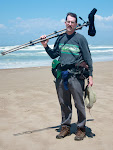
Leif Rydell and his family (photo left) visited us from Sweden, so I took three days off from my BIGBY to show Leif and his son Hannes some birds in my home territory. (Leif's wife and daughter did other things while we did most of our birding).


They arrived midday on June 19 so we birded nearby at Montana de Oro State Park (photo above). We went there to see Pigeon Guillemot (photo below) which nest in the cliffs at the park and which was new for them. We also had surprisingly good luck at the Bluffs Trail - finding five Pacific Rattlesnakes (photo), which Hannes really wanted to see. These snakes were very drably marked and acted very passively. That was a good thing since the snakes were all less than a foot off a very heavily used trail! I lifted one up gently with a tripod leg and it did not strike. It barely even rattled while sliding off into the weeds.


On the 20th, we went inland to Cerro Alto for birds which breed in riparian habitat away from the cool coast and for the slightly higher elevation which attracts birds like Olive-sided Flycatcher. At Cerro Alto, we met Ross and Mike Schaefer, and Aidan Briggs, from Templeton and Atascadero. They helped us to find many new birds for the Rydells, such as Black-headed Grosbeak, Western Wood-Pewee, a beautiful male Western Tanager, MacGillivray's Warbler (after some long looking for this bird that was singing in thick cover) and Pacific-slope Flycatcher. We also visited Whale Rock Reservoir where we found breeding Rufous-crowned Sparrow, Blue Grosbeak, and Lazuli Bunting (a gorgeous male that flew over tantalizingly, before finally perching in the open for good looks). We were also surprised by an adult Bald Eagle (unseasonal, but they do breed at reservoirs within 30 miles, as the eagle flies). Leif and Hannes had seen over a dozen new species that they had not seen on their prior visit to the area (in the winter).

On the 21st, Leif and I (Hannes decided to sleep in a bit) found a group of very vocal ("chi-beer") Cassin's Kingbirds (they seem to often breed near our coast in eucalyptus groves) on the way to Atascadero, where we saw Wood Ducks at the Wastewater Treatment Plant. Since access to the plant was denied, we viewed the birds from a hill on the outside of the fence.  While I couldn't really bird with these visiting birders on my bike, it was a fun bit of birding. I enjoyed birding with them and seeing the birds from their perspective. I was also glad that I didn't find anything I hadn't already seen on my BIGBY since I would not have been able to count it!

Thursday, June 3, 2010

More Local Birding

On May 16, I rode back to Montana de Oro Stae Park and cycled on the dirt and gravel road along Islay Creek, and hiked Coon Creek (about 4 and 5 miles from my house). While Islay Creek was full of bird song by birds like Lazuli Bunting and Rufous-crowned Sparrow, I could neither hear nor see any new BIGBY species. At Coon Creek I hiked and played recordings, but could scare nothing new out of the thick riparian habitat. (I did find another female Black-and-white Warbler - third for the year!) I also saw the pictured rabbit, morning glory flowers and coastal Live Oak along the Coon Creek trail (below).


On May 17, I did an after-work pedal over to the ponds at Turri Road and South Bay Blvd., where high tide floods some tidal flats at the north side of Los Osos. I found a Wilson's Phalarope (BIGBY # 272) (below) here with some Greater Yellowlegs. These shorebirds would not let me get too close, so I had to blow up a rather far away shot of them. This is a regular spot for phalaropes, but Wilson's is not often seen coastally in this county.

On May 19, Nike and I found a Rose-breasted Grosbeak (BIGBY # 273) (below) a couple of blocks away from our house, sitting in a sycamore on a vacant lot with a berry patch. It was a lucky find as it was not singing or calling. (Later, it did sing for a couple of local birders who went to look for it and was still singing off and on in the neighborhood four days later.)


On May 22, I packed my scope, tripod and camera, and cycled 4 miles out to the bluffs just north of Spooner's Cove at Montana de Oro State Park, to scope for pelagics. It was breezy and the visibility was incredible as I scoped from 7 AM till 9 AM. A moderate number of birds were moving - hundreds of Pacific Loons and a variety of other species. The best bird was a Xantus's Murrelet (BIGBY # 274), which shot by going to the north and I had long looks at it. Also new for the year were 2 Red-necked Phalaropes (BIGBY # 275) and three Elegant Terns (BIGBY # 276).

After walking Nike (the Rose-breasted was still in the neighborhood), I cycled around the Los Osos area on the morning of Sunday, May 23, checking several different locations for whatever might be passing through. Los Osos Oaks State Reserve (best early on a Sunday morning before the major traffic noise on Los Osos Valley Road) had a lot of bird activity in the front, where the water is flowing. While looking through the oaks for flycatchers and warblers I saw a female Varied Thrush (BIGBY # 277) just before it took off from the oak branch it was perched on and disappeared back into the preserve. The front of the preserve was birdy near the only flowing water there - the small stream that flows most of the year near the entrance. Western Tanagers sang their melodious song and Wilson's Warblers and Pacific-sloped Flycatchers answered with their not so melodic songs. Hutton's Vireos, Hairy Woodpeckers and an adult Cooper's Hawk (with a Western Scrub Jay in its talons) added to the bird activity near the front.

I left the Oaks and cycled through a partially wooded residential area on Willow Drive and Nipomo Avenue and then over to the riparian habitat along Turri Road. This stretch follows the course of an arm of Los Osos Creek and has had breeders such as Grasshopper Sparrow (across the road from the creek, in the pasture), migrants, and a few vagrants (e.g. Kentucky Warbler) in the past. This time I had to settle for Lazuli Bunting, Black-headed Grosbeak and other common breeders. Next, I accessed the extensive wooded habitat of Chorro Creek Willows from two locations along South Bay Boulevard - before and after the Chorro Creek bridge. I heard the haunting metallic song of the Swainson's Thrush and the "witchedy, witchedy' song of the yellowthroat, along with other breeders. I visited many spots on the way home along the edge of the bay and played a Black Rail recording at several locations, but this once regular but uncommon bird did not respond (it has apparently almost disappeared from the edges of Morro Bay). All of these locations were within a five mile radius of my home and made for a morning of birding and only about 12 miles of riding.


On the morning of May 24, Nike and I were doing our usual pre-work morning walk and bird with the usual suspects, when I received a call from Morro Bay birder Kaaren Perry. She had just seen a Black Swift against the overcast sky, about 2 blocks from where I stood. I looked up and about 30 seconds later it came over my head (BIGBY # 278) and I had time for only two quick photos (above) before it disappeared to the west. I knew I had been fortunate lately with my frequent new BIGBY species and that spring migration was slowing. I would have to really work for any new year birds from now until fall migration (which, for shorebirds, starts as early as late June with the return of some adults).

Wednesday, April 21, 2010

Sea Watch from Montana de Oro Sate Park


The ocean off the Central Coast of California is good for a variety of pelagic species, but most of them are best seen from a boat, often the farther out the better. Unless I could find someone with a sail boat who can get out without using any gas I was pretty much limited to what I could see from shore. Usually this has been pretty limiting. I have already scoped from the bluffs at Montana de Oro State Park, Morro Rock and North Point this year, for a total of about 10 times with only a few truly pelagic species. From what Richard Rowlett (expert pelagic birder and counter of sea birds from Piedras Blancas to the north of me) and Brad Schram (local expert birder, tour leader and author of Birder's Guide to Southern California) tell me, it seems that early morning is often the best and a strong onshore winds can help blow species closer to the coast.
Since the morning of April 21 was really blowing (which made land birding difficult)and since there was no court this morning, I pedalled down to the high point just north of Spooner's Cove and scoped from 9:00 till about 10:30 AM. I only lasted 1 1/2 hours due to the cold hard wind and the blowing sand. Birds were going both directions with the following going north: Pacific Loon (18), Brant (133), Surf Scoter (12), and Peregrine Falcon (1 adult). Local species going both ways were: Brandt's and Pelagic Cormorant, Pigeon Guillemot, Black Oystercatcher and Western Gull. Going south: Sooty Shearwater (6)(BIGBY # 236), Unidentified dark shearwater (probably Sooty) (40), Pink-footed Shearwater (1)(BIGBY # 237), Brown Pelican (1 adult), Ring-billed Gull, California Gull. I saw no terns, no alcids except the guillemot, and no shorebirds except the oystercatcher. Some of the shearwaters were too far out to ID.
I biked through the campground after leaving the sea watch, but it was very windy and starting to sprinkle, so I bailed and went home. I also needed the ride home to thaw out. Next time I will wear pants over my biking tights and I will bring another layer for my upper body. (I had worn a cycling jersey, long sleeved T-shirt, light cycling jacket and then added a fleece jacket and a rain coat at the overlook!). Sea bird watching is like pelagic birding on the Pacific Coast - I have to take more clothes than I think I will ever need!
(I have posted a photo of this sea watch spot taken on a more peaceful day when I wasn't afraid to let go of my tripod for fear of it blowing down.)

Tuesday, March 16, 2010

Pedalling for Poorwill


With the time change, giving me more time in the evening after work, and temperatures in the 70's on the coast, it seemed like a perfect evening on 3/16, to get my BIGBY Poorwill. I changed into my bike clothes, put on the wheels with wider tires onto my touring bike, packed my camera and lights, and headed out to Montana de Oro. I wanted to get to the top of Pecho Valley Road at 7:00 for the sunset, pictured here.
After the light show, I cycled out to Islay Creek Road where Steve Schubert had seen Poorwill. Just as I was starting out the dirt road along Islay Creek, three mountain bicyclist were coming down the road. I figured they had probably flushed any poorwills off the road and I hoped the birds would return. I proceeded about a mile or so up stream until I saw the first shape in the road, which flushed about the time I thought "Poorwill". This quick look was followed by another spotting of a Poorwill feeding from the road - fluttering 2 - 3 feet off the road and landing back on the road. I watched for about 5 minutes and then tried to take a picture. I used my bike light to illuminate the bird, whose eyes reflected red in the light. I then realized that my camera would not autofocus in the low light. I tried to hold the light with one hand and manually focus with the other. By the time I was able to do that, the bird had flow. I proceeded to go a short distance up the road and saw another Poorwill. Here I realized that my light's charge was low, so I decided to get down the dirt road before it was totally dark. Coming back I flushed 2 - 4 more Poorwills, including one which flew along side me, as I carefully coasted down the rocky road. The last Poorwill was just across the creek from the back of the state park campground, sitting on the road.
After getting to the paved road I put my flashing leg band on, and used the remaining headlight charge only when vehicles approached from head on. I could barely see the road when the light was off. Besides the exciting ride, I did hear the loud, clear, and incessant whistling of a Saw-whet Owl about 1/4 - 1/2 mile on the Los Osos side of Hazard Canyon (at 8:00 PM). I barely made it home before it was completely dark. The ten mile evening ride yielded BIGBY # 212.

Monday, March 15, 2010

Ready for Spring Migration


I was having a hard time finding more than one or two new birds in a day of birding and I was ready for some new birds to migrate here. On Sunday, March 14, my wife joined me for the ten mile round trip cycle out to Coon Creek Trail, Montana de Oro State Park. We went there to look and listen for Winter Wren (unsuccessfully)and to try to find any early migrants. We did find 5 Wilson's Warblers (BIGBY # 211), but I spent most of my time photographing wild flowers (nightshade and trillium shown here) and chasing butterflies because it was so slow bird wise. The 3 mile hike through the lush stream side habitat was enjoyable and the vistas on the bike ride at MDO are always breath taking.

Sunday, January 17, 2010

Spring Has Sprung?


The first wildflowers (like this Milkmaid) are blooming, the finches and sparrows are eating willow buds, and the first Allen's Hummingbird has returned. Spring must be near? No, I am living in coastal southern California and it is January 17. We do have four seasons (honest) - wet (winter), windy (spring), foggy (summer), and dry and mostly sunny (fall). It is wet now and all of the above things are happening.
I dash out to the seabird lookout (see map) at Montana de Oro on my bike - to get some birding in before the approaching storms. I pedal and a neighbor birder and his beginning birder friend meet me in their car. It is a beautiful spot, but the wind and prolonged observation of different colored specks that have different shapes and flight patterns is not the stuff to excite a beginning birder for long. Pacific Loons are streaming by to the south with Common Murres and a Rhino Auklet (new BIGBY). A nearby otter eating shell fish on its stomach and being harassed by a Western Gull provides some entertainment. We leave after less than an hour to try a quick hike at Coon Creek where it begins to rain and the birds are quiet. I then experience one of the downsides of bicycle birding - pouring rain.

Sunday, January 10, 2010

BIGBY Chasing


Chasing rarities is a little more of a challenge when you have to cycle to a bird, rather than drive to it. I have more time invested in a chase if I have to cycle twelve miles and hike 3 miles rather than driving and hiking 3 miles. This was the case with a Sage Thrasher, which my wife and daughter found on the local December 19 Christmas count. It had not been looked for since (as far as I knew) so it may may or may not still have been there. It was a bird I might not otherwise have seen on my BIGBY.
So, I decided to spend much of my morning looking for it today. My wife agreed to pedal over with me and show me where it was found. We locked our bikes at the kiosk for the Point Buchon Trail (PG&E property), just south of Montana de Oro State Park, and hiked out to Disney Point. From that location, the bird had originally been seen about 1/2 mile south - next to a boulder and rock pile, with bushes. Today it was not there! We searched all of the brushy area to the south of the boulder without luck. Just as we were about to leave, Celeste spotted the above bird perched on a bush over 100 feet away. It was too far away for a good photo, so I am posting the photo taken by my daughter on December 19th. A bird that you have to really work for is even more satisfying to find! We watched it for about ten minutes as it repeatedly flew to the ground to feed and then flew back to an open perch.

Sunday, January 3, 2010

Montana de Oro State Park


I was a little tired after my prior day's trip so I decided to do something different for my second BIGBY day. I also wanted to bird with a birding buddy, Ross, who was not doing a BIGBY and did not very live close by. So, I pedalled out to Montana de Oro State Park and met him (he was dropped off with his bike). We walked out to the bluff just to the north of Spooner's Cove and scoped the ocean for about an hour and a half from the highest vantage point - to see over the booming surf. It was active with dozens of Black-vented Shearwaters, many Common Murres, Pacific Loons, 3 species of cormorants, and other common birds. We couldn't find anything different, so we decided to check the creek mouth and the park's campground for Golden-crowned Kinglet and anything else we could find. We heard the high pitch calls of 2 Golden-crowned Kinglets in some cypress trees in the campground and after a long search found a pair inside one of the cypresses. Otherwise, the campground was very quiet and Islay Creek Mouth had a close perched Osprey, but not much else. Riding our bikes, we stopped at lower Hazard Canyon to look for Winter Wren and Rocky shorebirds (dipped). Then a quick stop at Upper Hazard to check a group off well-worked eucs. for sapsuckers, but only heard a distant one. About four hours off birding only yielded 3 new BIGBY species - flyby Semipalmated Plovers, the kinglet and House Wren!