Showing posts with label Cerro Alto. Show all posts

Sunday, July 4, 2010

Break from Green Birding


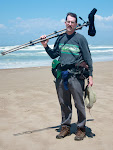
Leif Rydell and his family (photo left) visited us from Sweden, so I took three days off from my BIGBY to show Leif and his son Hannes some birds in my home territory. (Leif's wife and daughter did other things while we did most of our birding).


They arrived midday on June 19 so we birded nearby at Montana de Oro State Park (photo above). We went there to see Pigeon Guillemot (photo below) which nest in the cliffs at the park and which was new for them. We also had surprisingly good luck at the Bluffs Trail - finding five Pacific Rattlesnakes (photo), which Hannes really wanted to see. These snakes were very drably marked and acted very passively. That was a good thing since the snakes were all less than a foot off a very heavily used trail! I lifted one up gently with a tripod leg and it did not strike. It barely even rattled while sliding off into the weeds.


On the 20th, we went inland to Cerro Alto for birds which breed in riparian habitat away from the cool coast and for the slightly higher elevation which attracts birds like Olive-sided Flycatcher. At Cerro Alto, we met Ross and Mike Schaefer, and Aidan Briggs, from Templeton and Atascadero. They helped us to find many new birds for the Rydells, such as Black-headed Grosbeak, Western Wood-Pewee, a beautiful male Western Tanager, MacGillivray's Warbler (after some long looking for this bird that was singing in thick cover) and Pacific-slope Flycatcher. We also visited Whale Rock Reservoir where we found breeding Rufous-crowned Sparrow, Blue Grosbeak, and Lazuli Bunting (a gorgeous male that flew over tantalizingly, before finally perching in the open for good looks). We were also surprised by an adult Bald Eagle (unseasonal, but they do breed at reservoirs within 30 miles, as the eagle flies). Leif and Hannes had seen over a dozen new species that they had not seen on their prior visit to the area (in the winter).

On the 21st, Leif and I (Hannes decided to sleep in a bit) found a group of very vocal ("chi-beer") Cassin's Kingbirds (they seem to often breed near our coast in eucalyptus groves) on the way to Atascadero, where we saw Wood Ducks at the Wastewater Treatment Plant. Since access to the plant was denied, we viewed the birds from a hill on the outside of the fence.  While I couldn't really bird with these visiting birders on my bike, it was a fun bit of birding. I enjoyed birding with them and seeing the birds from their perspective. I was also glad that I didn't find anything I hadn't already seen on my BIGBY since I would not have been able to count it!

Friday, May 21, 2010

Cerro Alto Campground

Cerro Alto Campground is within Los Padres National Forest and is only about 8 miles from Morro Bay. On May 15 it was a 16 mile one-way ride from my home in Los Osos, with a moderate hill for the last couple of miles on Highway 41 before the turnoff to the campground. As is evident from my blog, I have birded at this location on many occasions. It is an excellent place for migration and it is good for breeding species. It is a great place to study bird song April through July!

On this particular trip I was pedalling to Cerro Alto to look for unusual migrants and to look for Black-chinned Sparrow, a local breeder that I had not yet seen for the year. As I was locking up my bike near the beginning of the entrance road at about 8:15, MacGillivray's Warbler was singing from a nearby oak and Warbling Vireo and Black-headed Grosbeak sang from the close by creek side riparian willows. It was hard to unpack, change clothes for hiking and lock up the bike when I was surrounded by various bird songs and calls that demanded attention for a student of birds and their vocalizations. After many interruptions, I finally got changed into hiking shorts and shoes I had brought, and put my pannier in a day pack with my lunch and anything else I did not want to leave with my bike.

As always, I walked the entire entrance road and up the trail past the end of the campground to check for migrants. There still were interesting migrants such as Hermit and Townsend's Warblers as well as the local breeders of interest such as Olive-sided Flycatcher and Western Wood Pewee. By the time I finished birding along the creek it was almost 10:00 and I hurried up the trail which climbs west out of the campground so I could look for Black-chinned before it got any later.

As I took the trail up out of the canyon, I passed a variety of blossoming wildflowers. The trail started in the shade of oaks and other trees, but gradually had fewer and fewer trees as I climbed up to the ridge top. I passed a Velvet Ant as I hiked. Not really an ant, it is a wasp and the female pictured is wingless. I've never seen a male, as far as I know.


Among the flowering plants was the yucca, with its beautiful spike of cream colored flowers. I must admit that I am not a fan of the cooked yucca root, at least as I have had it prepared for me in Central and South America. The flowers, however, are beautiful.


As I climbed over the top of the ridge I descended a short distance to a "T" where the trail met the trail coming down from Cuesta Ridge. The chaparral here had burned a few years ago and it looked good for Black-chinned. I played a recording since I thought it was getting late in the day for their song. Blue-gray Gnatcatchers and Bell's Sage Sparrows called and sang around me. I heard no Black-chinned so I took the trail toward the eucalyptus grove. After less than a quarter mile I heard a Black-chinned song (BIGBY # 271). I played the recording and heard a couple of others. One came close, but stayed in cover or too far away to photograph. A little further down the trail and a black-chinned sang right next to the trail. I managed to get the photo here. Another sang on the other side of the eucalyptus grove along with a couple of Rufous-crowned Sparrows.


As I hiked past the last of the Black-chinneds, I saw some movement of hairy legs go down a hole in the ground - slightly smaller than a gopher hole. It was the hole of a tarantula, but the spider would not come back to the opening as long as I stood there. If it had come out, I am not sure if I would have tried to pick it up. I had held them before, but I didn't know if that was wise when they are at their hole. I took a photo of the hole with a key for scale before finishing the hike back to my bike and then the ride home.

Saturday, April 24, 2010

Looking for Spring Migrants

My daughter was visiting for the weekend, so I took two morning bike rides on Saturday and Sunday, April 24 and 25. That way I could be back home not too long after she got up from bed. Whale Rock Reservoir and Cerro Alto Campground are two good spots in the spring and early summer. They are also far enough away from the coast for a good variety of breeders and close enough for relatively short bike rides from where I live (about 30 miles round trip for each).


On Saturday, on the way to Whale Rock I stopped near Morro Bay Sate Park and had a singing Olive-sided Flycatcher (BIGBY # 238) at its annual spot in eucalyptus trees near the Ranger residence along State Park Road. I didn't even have to get off my bike to here "Drink three beers!" Whale Rock had great birding along Cottontail Road, which parallels the main creek that feeds into the reservoir. On the down slope side, the thick riparian habitat had a variety of singers, including Black-headed Grosbeak, Bullock's Oriole, Yellow-breasted Chat (BIGBY # 239), Wilson's Warbler, etc. On the drier pastureland uphill side of the road Blue Grosbeaks, Rufous-crowned Sparrows and Lazuli Buntings sang. The views of the lake are great from here as well. I stopped on the way home to watch Cliff Swallows getting mouth fulls of mud from a wet spot near the road, for their nest building.

On Sunday I rode up to Cerro Alto Campground - located in a canyon about eight miles from the coast. I had a great variety of singing species all along the road and up onto the trail from the back of the campground, but nothing new for the year. I did manage a photo of the local Merriam's Chipmunk, which is quite shy. On the way home I took a short detour on Turri Road, into a ranching area near the coast. A low wet spot here surprisingly had a Green Heron (BIGBY # 240).


I will not have a Bird ID Challenge for a couple of weeks as I am taking off on a nine day, 500+ mile solo bicycle ride to the South Fork of the Kern River, the Greenhorn Mountains, and the Mojave Desert. I depart early Tuesday, April 27.

Saturday, April 17, 2010

Tree-Top Migrants


Migration on the coast just wasn't happening, and Cerro Alto had been getting good reports. So, I took the morning off of work on April 16 and pedalled the 15 miles from my house near the coast to this Los Padres National Forest campground. The ride up is not overly steep, but an offshore wind in my face (deja vu) made me work. I did hear the buzzy call of Lazuli Buntings along the way (Bigby # 225), in an overgrown pasture area with scattered brush.
Cerro Alto Campground is about about 7 miles from the coast and a little over 1,000 feet in elevation. What a difference this short distance made for migrants! The very first bird I heard after locking up my bike off the road, was a MacGillivray's Warbler (Bigby # 226). I arrived at about 9:00 AM after the 1 1/4 hour ride and the "Mac" was singing continuously from up in a large oak - his male hormones had him boldly singing where this species normally doesn't go - except when trying to attract a mate. House Wrens, robins, Spotted Towhees, and creepers sang along with him. The entrance road is surrounded by large oaks (photo) and nearby is the willow riparian habitat along the East Fork of Morro Creek. The few open sunny areas had wildflowers like the pictured Hummingbird Sage - a favorite of the local hummers.

Shortly after placing my pannier into my day pack and covering my screaming yellow bike jacket with a green shirt, I was ready to hike the road up to the campground and then up the trail to look for more recent arrivals. As I approached the road I saw two other experienced local birders - Tom and Maggie. I welcomed their company with the extra eyes, and we made our way along the creek. Black-headed Grosbeaks sang from the creekside sycamores and willows, and American Robins gave their similar song from the oaks across the road. An unfamiliar warbler song came from deep into the willows and after much searching and pishing a bright male Nashville Warbler showed itself. For the rest of the paved road we saw and heard many birds including several very vocal Cassin's Vireos (local breeders and BIGBY # 227), and Western Wood Pewee (BIGBY # 228) and Ash-throated Flycatcher (BIGBY # 229) at the tops of sycamores. Just before starting up the trail another song similar to a robin, but a little more burry than what we had heard so far that day, was a Western Tanager (BIGBY # 230). It too was way up in a sycamore, showing of his red head and bright yellow underparts. At this poinbt we also ran into Alan and Kaaren, two other local birders who told us what they had up the trail. More good birds were ahead!
After getting onto the trail which goes up from the end of the campground, we started hearing the thin song of a Townsend's Warbler, which eventually led us to a large flock of warblers and flycatchers, which included a sharp looking male Hermit Warbler with his bright yellow face, black bib and white underparts (BIGBY # 231). A couple of Black-throated Gray Warblers (BIGBY # 232) were in the same flock, as were Pac-slope Flycatchers, Yellow-rumped Warblers and more Townsend's. We left the flock as we went further up the trail, and the habitat changed, so we turned around and went back down to the entrance, happy with all the nice migrants we had seen. I left with no satisfactory photos of any of these birds since they had all been way up in the tall trees, but I did post one poor picture of the Mac.

Saturday, April 3, 2010

Back In the Saddle Again!

I was able to hike for the first two days after my bike accident, ride a stationary bike on the third day, ride a short distance on the road on the fourth, and back in the gym on the sixth (where it hurt less to breath than before). Seven days after breaking my ribs I decided to try and go for a hilly 30 mile round trip to Cerro Alto (a campground about 8 miles inland from the coast with riparian and chaparral) and look for some new BIGBY species. I was surprised - the ride was fairly easy! I hit the eight mile mark at 27 minutes, and had not been pushing it, so I knew I was OK. The climb up Highway 41 (the shoulder and visibility to cars is acceptable as you ride inland) was not too bad and I locked my bike up near the entrance with plenty of energy for a hilly 5 mile hike.


It was noisy with bird song as I walked up the entrance road to the campground, following the creek. It was also cold and my sweaty clothes didn't help, even though I changed into a fresh dull green shirt for my hike (put my "screaming yellow" bike jacket in my pack). I should have brought a thermal shirt. House Wrens sang their beautifully complex song, Yellow-rumped and Townsend's Warblers sang an accompaniment from the willow tops and sycamores along the stream. Two Black-headed Grosbeaks (BIGBY # 220) sang for a nearby female. Brown Creepers, Spotted and California Towhees, Wilson's Warbler, Warbling Vireo, Hairy Woodpeckers, and Swainson's Thrush (BIGBY # 221) added to the avian symphony. I was unable to find the Cassin's Vireo seen by Maggie earlier in the week so I decided to take the trail up from the campground and look for Mountain Quail. The flowers were more conspicuous than the bird, such as the clematis pictured here. Ceanothus was blooming all around the trail (photo).
As I got out of the lusher vegetation on the campground side of the ridge, I came into more open and drier chaparral with manzanita and a different set of resident birds such as Wrentit, Blue-gray Gnatcatcher (photo) and Bell's Sage Sparrow (pictured). Many of these birds were local breeders and were acting very territorial. As I neared a grove of eucalyptus I heard Mt. Quail (BIGBY # 222) call and flushed a couple from within the grove. I wasn't able to get close enough to one in the open for a photo.

The views all along the trail were incredible and it was a very enjoyable hike till I took a wrong fork and ended up on Highway 41 about a half mile below the road where my bike was parked. The ride back was uneventful except for the 2 mile stretch on Highway 41 where there was no bike lane or shoulder, and I was right next to the slope where my visibility in turns was poor. Most drivers were courteous, but one blared its horn angrily in a spot where I could get over no farther. I need to be better about controlling my language in response to such behavior!

This gnarley gnatcatcher was defending his territory!