Friday, July 30, 2010

The Shorebirds Are Back!


The shorebirds are back in full force as their southward "fall" migration is going "great guns". I saw my first adult migrating shorebird (only oystercatchers, Snowy Plover, Killdeer, and maybe Spotted Sandpipers nest near the coast here) on July 4 when some Western Sandpipers stopped at San Simeon Creek Mouth (see the above photo of a defensive postured adult Western from there on 7/18). (Some years the southbound shorebirds arrive as early as the last week in June!) Adult Leasts and other adult shorebirds arrived within days of the first Westerns. (see the photo of an adult Whimbrel and the very rare Double-decker Dowitcher below, taken at Old Creek Mouth on 7/11.) The juveniles start to arrive later, with my first sightings being juvenile Willet and Whimbrel on July 18.


The "fall" shorebird season (which extends into October) started off with a bang. I found an adult Stilt Sandpiper (the bird in the back, behind the adult G. Yellowlegs in the photo above) at Turri Road Ponds (tidal ponds near the edge of Morro Bay estuary) which was only the fourth record for the county. While looking for the Stilt, Bill Bouton and Maggie Smith found an adult Red-necked Stint in a nearby part of the bay on 7/10 - a very rare vagrant for all of California, from Asia/Alaska! When I got the call for the stint, I was sitting on my living room couch, eating chocolate and watching the re-broadcast of the day's Tour de France Stage (I was thinking it would be interesting if each cyclist had to find a set number of bird species before finishing each day's stage. I could hear the announcer Phil Liggett saying, "Alberto Contador may be a great hill climber and time trialist, but he really needs to work on his recognition of bird song if he expects to win the Tour.") I ran to change my clothes, pack the bike and tear on over to the edge of the bay about 3 miles pedal away. As I got there, people were walking slowly away from the location where the bird had been (not a good sign) and shrugging their shoulders. Apparently, a vulture had flushed the bird which disappeared over the bay to the west, just 5 minutes prior! (Expletives deleted!)


Local birder, Kaaren Perry found an adult Pectoral Sandpiper on 7/20 at the same location as the Stilt Sandpiper, called me, and waited for me. This bird was nice enough to be there after another hurried cycle from my house; I only had to go up and look through Kaaren's scope at this bird! I had seen an adult Pectoral in this county once before. (I took the photo to the left of the Pec. from far away and blew it up many times bigger.) Summer early evening high tides were really good for shorebirds at this location and the adjacent part of the bay.


Semipalmated Sandpipers are an unusual shorebird species in California - we see maybe one or two most each year in this county. This shorebird migration produced many around the state, but I was still excited to find one at Oso Flaco Creek Mouth on 7/24. I called other birders about this juvenile (photo left) and learned that while I had one, there were two at San Simeon! (At least I didn't have to cycle over 60 miles to the north to see them for my BIGBY!) There were 15 species of shorebirds at the creek mouth including 2 Wilson's Phalaropes, Snowy Plovers, an out-of-place looking Black Turnstone, and many Semipalmated Plovers. I also saw several Least Terns (yes, I know its not a shorebird) at Oso Flaco Lake, but had problems photographing them in flight as they were too quick. (See my not so sharp photo below)


On 7/25, I again cycled out to the Turri Road Ponds and found a sharp looking juvenile Lesser Yellowlegs, joined by a couple of adult Greater Yellowlegs for comparison and a female Wilson's Phalarope. Also on 7/25, Tom Edell had a Wandering Tattler at Estero Bluffs beach, but I did not have time to cycle there. This was a species that I had missed a number of times already for the year. So, when Kaaren called me at work on 7/26 to tell me that she had two tattlers there, I planned to ride my bike there after work (work certainly gets in the way of birding and other fun). By the time I got home and ready for my ride, however, I only had 2 1/2 hours of daylight left to cycle the 16 miles to the bluffs, park my bike, transfer valuables to my pack, change my shoes and shirt, hike out to the beach, find the bird, and then ride home. With a headwind in parts, it took me a good hour to get to the trailhead for the bluffs trail. Rather than take the time to change and lock my bike, I took my bike out to the beach. (Bikes are prohibited from this trail, but no one else was on the trail and I saw no harm in pedalling out as long as I stayed on the trail.) This gave me the extra time I needed to find a tattler (see the photo below of a tattler that was hiding on the back of a boulder.) It took me 25 minutes to find this bird, so I had to jam back to the highway and then cycle home. I didn't stop on the 16 mile pedal home and barely made it home before dark. I got a new BIGBY species and a good workout.


On 7/31 I headed up the coast to stop at several shorebird spots between Los Osos (where I live) and Villa Creek Mouth (18 miles to the north). My third stop was at Old Creek Mouth, where I ran into Aidan Briggs. He was on all fours in the sand and mud, sneaking up to some peeps for a good picture. I saw that one was a juvenile Semiplamated Sandpiper, the fourth in the county in the last week! I waited and when he was done I looked more carefully at the Semi.(below). He said he would call me if he saw the Red Phalarope he had found down the beach a couple of days earlier. I pedalled north and realized after about four miles that he had left me a message, which indicated that he had re-found the phalarope. I turned around and rushed back to see and photo the bird (below), BIGBY # 285 for 2010. It was tame and I got close photos. I later continued up to Villa Creek where I had another adult Pectoral Sandpiper that would not let me get close enough for a photo. I also hiked Estero Bluffs trail and found a couple of Wandering Tattlers and Spotted Sandpipers that were spotted (usually when I see them they are plain). I had a total of 19 species of shorebirds for the day, but missed Sanderling which would have been number 20.


I have posted a photo to the right of a partially breeding plumage Sandering taken at Villa Creek Mouth on 7/11 because it is in a plumage that could cause an overeager birder to identify it as a Red-necked Stint, or some other rarity, when it is actually a very common local species.

Juvenile Birds


Young birds can be confusing both in the way they look and the way they sound. It makes it much easier to identify them when an adult is nearby, but the lone youngster can sometimes be confusing. I have often chased after a bird sound which I don't recognze just to find that it is a common species, but a young individual. When I see these juveniles, they can be harder to ID or just as obvious as the adults, depending on the species. The young Cliff Swallow (San Simeon Creek, 7/4) and Pygmy Nuthatch (Cambria, 7/4) above are still obvious, but the turkey (Poly Canyon, 7/16) and the White-crowned Sparrow (Morro Rock, 6/20) below might demand a second look before identifying them. It is a fun challenge for me to ID the calls of such young birds.


Thursday, July 29, 2010

Spring and Early Summer Land Birding


Between mid May and mid July, I checked many of the riparian habitats close to the coast, as well as Cerro Alto, a riparian site in the hills about 7 miles from the coast. These have been locations which in past late springs and early summers have had unusual warblers, tanagers, grosbeaks, etc., often in breeding plumage. This year such birding was not productive as there were practically no such vagrants. I did find sharp looking common local breeders such as the Wilson's Warbler pictured (Coon Creek) and pretty butterflies like the Satyr Comma pictured (Coon Creek), but I spent a lot of time land birding locally with no new BIGBY species. One of the few exceptions was a brief female American Redstart in some willows near the edge of the bay in Los Osos on July 1. It was there for about ten minutes and then was never seen again. I could not get a photo of this bird, which seemed to be in a hurry.

Sunday, July 4, 2010

Break from Green Birding


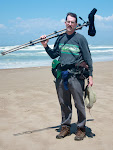
Leif Rydell and his family (photo left) visited us from Sweden, so I took three days off from my BIGBY to show Leif and his son Hannes some birds in my home territory. (Leif's wife and daughter did other things while we did most of our birding).


They arrived midday on June 19 so we birded nearby at Montana de Oro State Park (photo above). We went there to see Pigeon Guillemot (photo below) which nest in the cliffs at the park and which was new for them. We also had surprisingly good luck at the Bluffs Trail - finding five Pacific Rattlesnakes (photo), which Hannes really wanted to see. These snakes were very drably marked and acted very passively. That was a good thing since the snakes were all less than a foot off a very heavily used trail! I lifted one up gently with a tripod leg and it did not strike. It barely even rattled while sliding off into the weeds.


On the 20th, we went inland to Cerro Alto for birds which breed in riparian habitat away from the cool coast and for the slightly higher elevation which attracts birds like Olive-sided Flycatcher. At Cerro Alto, we met Ross and Mike Schaefer, and Aidan Briggs, from Templeton and Atascadero. They helped us to find many new birds for the Rydells, such as Black-headed Grosbeak, Western Wood-Pewee, a beautiful male Western Tanager, MacGillivray's Warbler (after some long looking for this bird that was singing in thick cover) and Pacific-slope Flycatcher. We also visited Whale Rock Reservoir where we found breeding Rufous-crowned Sparrow, Blue Grosbeak, and Lazuli Bunting (a gorgeous male that flew over tantalizingly, before finally perching in the open for good looks). We were also surprised by an adult Bald Eagle (unseasonal, but they do breed at reservoirs within 30 miles, as the eagle flies). Leif and Hannes had seen over a dozen new species that they had not seen on their prior visit to the area (in the winter).

On the 21st, Leif and I (Hannes decided to sleep in a bit) found a group of very vocal ("chi-beer") Cassin's Kingbirds (they seem to often breed near our coast in eucalyptus groves) on the way to Atascadero, where we saw Wood Ducks at the Wastewater Treatment Plant. Since access to the plant was denied, we viewed the birds from a hill on the outside of the fence.  While I couldn't really bird with these visiting birders on my bike, it was a fun bit of birding. I enjoyed birding with them and seeing the birds from their perspective. I was also glad that I didn't find anything I hadn't already seen on my BIGBY since I would not have been able to count it!

Feeling Old?

My fractured ribs were healing and feeling better until I tore a calf muscle playing squash on May 28 - the Friday before Memorial Day weekend. I figured it was just a "Charlie Horse" when I rode the 100 miles up the coast to Ragged Point and back on Saturday and Sunday, and then rode my bike 30 miles up to Cerro Alto and hiked the hilly trails on Monday. The cycling seemed to make the calf feel better, but the hiking worsened the injury. What had been stiffness and soreness in my calf (with minimal swelling) became a more painful calf with considerable swelling into my ankle and my now red, purple and blue foot. My doctor said it was a torn muscle and that I should lay off of exercise for at least 2 weeks. Some of my friends said I should act my age! (I also had a scraped-up hand from slipping on a closed gravel path at Ragged Point.)

After a week of no leg exercise, I began with short rides which seemed OK. I avoided steep hills on my bike, and did not even try to run or hike. On June 16 I took the morning off of work, since the superior courts were not in session, and rode south to the Bob Jones Bike Trail, an asphalt trail through riparian habitat along San Luis Obispo Creek before it flows out to the coast. This mostly forested stretch had willows, oaks, cottonwoods, walnuts, and other trees and plants. (see the photos)


I listened for any unusual calls or songs from the sometimes thick riparian forest, but found nothing unusual. I did find 48 species of birds along the bike path, including this Red-shouldered Hawk (photo below) hiding in the shade next to the busy path. The path highlighted a good range of species from breeding passerines, to nesting Great Blue Herons, to raptors, overhead swallow flocks, to birds of the beach and coast near the creek mouth.
I turned around at the Harford Pier for the back stretch of my 25 mile ride. I fought a head wind on the way back to San Luis Obispo, but got back in time for an afternoon of work. I decided I wasn't feeling old, just injured from some
                bad luck. I was on the mend. At least I could still cycle!

Saturday, June 5, 2010

Trip to Ragged Point and Back

I had planned to cycle north on Highway 1, on May 29 to look for Black Swifts reported from Black Swift Falls near the Ragged Point Inn. I also wanted to spend the night there with my wife for our anniversary; tick off 2 birds with one cycling trip, so to speak. Since I saw a Black Swift on the prior Monday near my house, I cycled up for my anniversary and whatever species I might see on the way there or back, along the coast. After walking the dog and doing some other husbandly chores, I didn't get on the road till about 9:30 - just in time for the onshore wind from the northwest! I potentially had 50 miles of headwinds ahead! I also had a sore left leg from an injury I got the day before - playing doubles squash.

Fortunately, the wind was only bad in a couple of spots and my leg felt alright once I warmed up. I didn't stop much along the way unless I saw or heard something worth stopping for. I did hear some Cassin's Kingbirds near Harmony, in some eucalyptus trees at a farm next to the highway. There were several, with a couple making their burry two note call from trees and power lines. A Bullock's Oriole also chattered nearby. A little farther up the coast three Greater Yellowlegs (late in the season) called as they flew up from a small wetland bordered by pasture and the road. The white rumps on these medium sized shorebirds showed as they circled and landed behind some green cover, between pools of water. I had a planned stop at Santa Rosa Creek, a willow lined watercourse that flows through the small artsy tourist town of Cambria and out to the coast. Many common breeders such as Black-headed Grosbeak and Wilson's Warbler sang from the thick cover, but I heard nothing unusual. I stopped for lunch at a liquor store that has tables overlooking a pond and Pico Creek, at the north end of San Simeon (where tourists stay to go to Hearst Castle).


I arrived at the Ragged Point Inn at about 3 PM (Celeste arrive about an hour later). The only steep hill between there and Los Osos was right before the Inn. The wide bike lane along Highway 1 ended about 5 miles south of the Inn. Our room was elegantly comfortable and the Inn's large grassy area, surrounded by flowers and cypress trees, had a great view of the ocean below. White-throated Swifts and Cliff Swallows flew overhead and finches and an Olive-sided Flycatcher sang from the trees. I sat in the warm sun in our room's patio and watched and listened to the birds as they darted around overhead. I was glad I had already seen the Black Swift for my BIGBY as there were no large all-dark swifts in the area that I could see. (I could find none at the end of the day or early the next morning either). I did stand next to the cypress trees at the edge of the grounds and watched the sun sink into the ocean that stretched out below. First the sun flattened into a bright yellow pancake and then it shrank from the left and right side to a dot in the center before going out totally.


The weather at the Inn was sunny and warm on Saturday and Sunday. We did a little walking around the the Inn and up a nearby dirt road that went up the hill on the inland side of the highway. We ate our meals at the Inn's restaurant. We found a table outside next to the lily pond that had a great view of the grounds and the bright blue sky as we ate our breakfast.

After breakfast, I packed up my bike and we loaded the car Celeste was driving. We had planned to meet at the trail out to Ragged Point, but neither of us could find the trailhead from the road, so we decided to meet at the elephant seal spot just south of Piedras Blancas instead. I stopped at a wetland a little south of the old Piedras Blancas Motel and saw a lone out-of-place looking White-faced Ibis that I had missed on the way up. I also passed a herd of Tule Elk further south- just north of Arroyo de la Cruz! (What are they doing there?)

My wife and I walked around the elephant seal lookout and took pictures. I was not sure what was more amusing - the seals with their loud burping sounds and mock fighting, or the tourists with strange calls and varied plumages. We agreed to stop for lunch at Soto's Market in Cambria. I found a mixed flock of black birds near the intersection of Highways 1 and 46 that contained a dozen or so Tricolored Blackbirds among the Brewer's and Red wingeds. At Soto's, my wife ate a large sandwich and I had a portabllo mushroom stuffed with crab.  We ate across the stret on a bench in front of the bank and we were serenaded by an old guy playing a guitar and singing Beatle's and other tunes from the sixties.
I rode the 28 miles home from Cambria without any stops. I had enjoyed the bike ride (and the romantic anniversary stay!), but had no new BIGBY species to show for 100 miles of riding (the ibis was a new county BIGBY bird though).

Thursday, June 3, 2010

More Local Birding

On May 16, I rode back to Montana de Oro Stae Park and cycled on the dirt and gravel road along Islay Creek, and hiked Coon Creek (about 4 and 5 miles from my house). While Islay Creek was full of bird song by birds like Lazuli Bunting and Rufous-crowned Sparrow, I could neither hear nor see any new BIGBY species. At Coon Creek I hiked and played recordings, but could scare nothing new out of the thick riparian habitat. (I did find another female Black-and-white Warbler - third for the year!) I also saw the pictured rabbit, morning glory flowers and coastal Live Oak along the Coon Creek trail (below).


On May 17, I did an after-work pedal over to the ponds at Turri Road and South Bay Blvd., where high tide floods some tidal flats at the north side of Los Osos. I found a Wilson's Phalarope (BIGBY # 272) (below) here with some Greater Yellowlegs. These shorebirds would not let me get too close, so I had to blow up a rather far away shot of them. This is a regular spot for phalaropes, but Wilson's is not often seen coastally in this county.

On May 19, Nike and I found a Rose-breasted Grosbeak (BIGBY # 273) (below) a couple of blocks away from our house, sitting in a sycamore on a vacant lot with a berry patch. It was a lucky find as it was not singing or calling. (Later, it did sing for a couple of local birders who went to look for it and was still singing off and on in the neighborhood four days later.)


On May 22, I packed my scope, tripod and camera, and cycled 4 miles out to the bluffs just north of Spooner's Cove at Montana de Oro State Park, to scope for pelagics. It was breezy and the visibility was incredible as I scoped from 7 AM till 9 AM. A moderate number of birds were moving - hundreds of Pacific Loons and a variety of other species. The best bird was a Xantus's Murrelet (BIGBY # 274), which shot by going to the north and I had long looks at it. Also new for the year were 2 Red-necked Phalaropes (BIGBY # 275) and three Elegant Terns (BIGBY # 276).

After walking Nike (the Rose-breasted was still in the neighborhood), I cycled around the Los Osos area on the morning of Sunday, May 23, checking several different locations for whatever might be passing through. Los Osos Oaks State Reserve (best early on a Sunday morning before the major traffic noise on Los Osos Valley Road) had a lot of bird activity in the front, where the water is flowing. While looking through the oaks for flycatchers and warblers I saw a female Varied Thrush (BIGBY # 277) just before it took off from the oak branch it was perched on and disappeared back into the preserve. The front of the preserve was birdy near the only flowing water there - the small stream that flows most of the year near the entrance. Western Tanagers sang their melodious song and Wilson's Warblers and Pacific-sloped Flycatchers answered with their not so melodic songs. Hutton's Vireos, Hairy Woodpeckers and an adult Cooper's Hawk (with a Western Scrub Jay in its talons) added to the bird activity near the front.

I left the Oaks and cycled through a partially wooded residential area on Willow Drive and Nipomo Avenue and then over to the riparian habitat along Turri Road. This stretch follows the course of an arm of Los Osos Creek and has had breeders such as Grasshopper Sparrow (across the road from the creek, in the pasture), migrants, and a few vagrants (e.g. Kentucky Warbler) in the past. This time I had to settle for Lazuli Bunting, Black-headed Grosbeak and other common breeders. Next, I accessed the extensive wooded habitat of Chorro Creek Willows from two locations along South Bay Boulevard - before and after the Chorro Creek bridge. I heard the haunting metallic song of the Swainson's Thrush and the "witchedy, witchedy' song of the yellowthroat, along with other breeders. I visited many spots on the way home along the edge of the bay and played a Black Rail recording at several locations, but this once regular but uncommon bird did not respond (it has apparently almost disappeared from the edges of Morro Bay). All of these locations were within a five mile radius of my home and made for a morning of birding and only about 12 miles of riding.


On the morning of May 24, Nike and I were doing our usual pre-work morning walk and bird with the usual suspects, when I received a call from Morro Bay birder Kaaren Perry. She had just seen a Black Swift against the overcast sky, about 2 blocks from where I stood. I looked up and about 30 seconds later it came over my head (BIGBY # 278) and I had time for only two quick photos (above) before it disappeared to the west. I knew I had been fortunate lately with my frequent new BIGBY species and that spring migration was slowing. I would have to really work for any new year birds from now until fall migration (which, for shorebirds, starts as early as late June with the return of some adults).